International medical graduates (IMGs) search for friendly residency programs when it comes to applying for medical residency in the United States. Many residency programs have never accepted IMGs in the past, and many IMG friendly programs only accept US citizens, despite their ability to sponsor or accept visas. Additionally, all residency programs have their own criteria to shortlist candidates. As a result, it is very important for an IMG to have a personalized list of IMG-friendly residency programs in the United States that offer chances of a match with his/her qualifications. In this article, we answer the most frequently asked questions that IMGs ask.
In 2026, NRMP reported 60% match rate among IMG applicants who submitted a certified rank order list according to the PGY-1 main residency match. The match rate is 70% for US IMGs and 56.4% for non-US IMGs. While the statistics look promising on paper, let’s look a bit deeper at the numbers. NRMP suggests that applicants who get no interviews should not submit a rank order list. So, what is the real IMG residency match rate? To calculate the true match rate among IMGs, we also need to consider those who applied but did not receive any interview invitations. Therefore, we divide the number of those who matched by the total number of applicants who matched, did not match, or did not submit a rank order list. Based on these calculations, the match rates for US and non-US IMGs are roughly 60% and 49%, respectively, which is not as promising as the rates for interviewed applicants.
Let's look at the graph. The match rate increased by 10-12% during the past 9 years. In 2021 pandemic year, it was very difficult to meet residency program requirements even for US-IMGs, and the match rate temporarily decreased by 5%. The match rate recovered in 2022-2026 reaching the highest ever level of 60% for US-IMGs. This record high phenomenon can be easily described by the fact that the number of US IMG applicants decreased by 12%.
But for non-US IMGs the situation is different. The number of applications increased by 27% over the past three years, and 2025-2026 50-49% match rate indicates a parallel rise in available non-US IMG friendly positions. This is a good sign, despite the highest pre-pandemic level of 51% is not reached. However the competition is intense, leaving the half of all candidates unmatched. Moreover, 50% is not like match or not match with the equal probability. The probability of a match strongly depends on applicant's qualification and drops to approximately 30% and lower for an average applicant.
- States, specialties, and individual residency programs that historically accept a high number of international medical graduates are commonly referred to as IMG-friendly.
Medical residency programs in the United States are very friendly for US medical school seniors, who enjoy a match rate of 94%. On the other hand, the match rate for IMGs varies from 0% to 60% depending on specialty. Under these circumstances, IMGs face questions like: Should I search for certain states to apply? What is the right specialty to apply for?
How can I find foreign medical graduate friendly residency programs? Every IMG asks these question when he/she starts to look for medical residency in the USA.
While it is possible to find IMG friendly residency programs pdf files, lists, and databases on the Internet, it is still not easy to choose the right programs to apply to. An applicant's qualifications are undoubtedly very important for a successful match, but thoughtful program selection can be equally important in many cases. Choosing the wrong programs can leave even the strongest candidate unmatched.
Here at ResidencyProgramsList, we try to make these things clear for IMGs.
- If a program accepts IMGs who score above a certain score on the USMLE exam or possess other minimum qualification, it should be considered as IMG friendly. ResidencyProgramsList considers a program as IMG friendly only if it has a history of previously matched IMGs. High percentages of IMGs obviously identify programs which are very IMG friendly, however many programs have specific preferences and not friendly for certain types of candidates. On the other hand, competitive programs may have just 20 or lower percentage of IMGs, but often this percentage correlates with low percentage of applications from IMGs. This fact surprisingly makes such programs IMG friendly for well prepared candidates. It is important to understand that not all residency programs in the United States accept international medical graduates. There are a lot of programs that declare that they can accept IMGs and sponsor visas but in reality, many of them have never had IMGs. Moreover, there is a big difference between IMGs who have US citizenship or permanent residence and those who require visa. Even in those programs that declare accepting J1 and sponsoring H1 visa for IMGs, there may be no visa requiring IMGs. This is why for IMGs without US citizenship/permanent residence (commonly called non-US* IMGs) the whole matching process can be even more competitive. Programs often have graduation preferences based on connections with certain geographical area. For example, some programs accept Caribbean graduates only, some programs accept a lot of Asian graduates, while some other programs never accepted a graduate from Asia. As result, often IMGs need look for residency programs that are friendly towards non-US IMGs instead of just IMG friendly programs, for programs that are specifically friendly towards certain geographical area, for programs that are friendly toward applicants with a longer time since graduation, for IMG friendly residency programs in the USA that have light USCE requirements, etc. ResidencyProgramsList helps IMGs to find really IMG-friendly programs that friendly for certain candidate profile. *- NRMP uses term non-US IMG for not U.S. citizens at the time of medical school graduation outside the U.S. even if citizenship obtained later.
AMA's FREIDA and AAMC Residency Explorer are not the bad sources of IMG-friendly lists for a strong US-IMG applicant. However, very often, an application is not as efficient as it can be.
IMG-friendly programs listed in these databases receive thousands of applications and become very competitive. Our ResidencyProgramsList tool approach narrows down the list of programs and ranks programs by compatibility using collected statistical data and unique mathematical algorithms to find really friendly programs for a certain candidate.
By default, ResidencyProgramsList provides a free list of residency programs in the United States for IMGs that satisfy selected visa requirements. The free list includes information about well-known IMG-friendly programs, links to program websites, and basic characteristics of the program. Each applicant can research residency programs, write own notes, and do several rounds of selecting and bookmarking.
Our paid lists include all information that was pre-collected by our staff: program-specific notes and additional requirements, past years' NRMP insights, the percent of residents from the applicant's country and school, and information about all known IMG-friendly programs. The ResidencyProgramsList advanced list provides a graduation diagram and ranks programs by compatibility.
The Friendly score is calculated using precise methods of mathematical statistics by country of graduation, scores, percentages of US/non-US IMGs, program competitiveness, required clinical experience**,** and many other important factors. Selecting programs from the top and middle of the ordered list helps to maximize the number of friendly positions with a reasonable number of applications. The algorithm is specially designed for IMGs and completely different from the one for U.S. graduates. This makes ResidencyProgramsList the best, most specifically tailored tool for IMGs.
Internal medicine 1403521470 Lincoln Medical and Mental Health Center New York
— 1403521316 SUNY Upstate Medical University New York
— 1403511264 One Brooklyn Health System/Brookdale University Hospital and Medical Center New York
Anesthesiology 0401612039 Cook County Health and Hospitals System Illinois
— 0402531073 Detroit Medical Center/Wayne State University Michigan
— 0403521110 SUNY Downstate Health Sciences University New York
Neurology 1804811109 University of Texas Medical Branch Hospitals Texas
— 1803521083 SUNY Upstate Medical University New York
— 1803521079 SUNY Downstate Health Sciences University New York
Emergency medicine 1104700001 HCA Healthcare/TriStar Nashville/Skyline Medical Center Tennessee
— 1103512031 New York Medical College (Metropolitan/Harlem) New York
— 1103512053 Lincoln Medical and Mental Health Center New York
Radiology-diagnostic 4204121170 Mercy Catholic Medical Center Pennsylvania
— 4203521147 SUNY Upstate Medical University New York
— 4200421012 University of Arkansas for Medical Sciences (UAMS) College of Medicine Arkansas
Otolaryngology - Head and Neck surgery 2805511113 West Virginia University Program West Virginia
— 2802321047 Johns Hopkins University Maryland
— 2801821039 University of Iowa Health Care Medical Center Iowa
Orthopaedic surgery 2603431093 University of New Mexico School of Medicine New Mexico
— 2601100220 Larkin Community Hospital Florida
— 2602821148 University of Missouri-Columbia Missouri
Transitional year 9993300243 Hackensack Meridian Health/Palisades Medical Center New Jersey
— 9990500004 Desert Regional Medical Center California
— 9992500060 Detroit Medical Center/Wayne State University Program Michigan
Dermatology 0800721022 University of Colorado Colorado
— 0801100143 Larkin Community Hospital Florida
— 0803521065 SUNY Downstate Health Sciences University New York
Family medicine 1200300718 Onvida Health/Yuma Medical Center Arizona
— 1204821457 Texas Tech University (Permian Basin) Program Texas
— 1203521465 BronxCare Health System New York
Neurological surgery 1603521050 University at Buffalo Program New York
— 1602621042 University of Minnesota Minnesota
— 1601811028 University of Iowa Health Care Medical Center Iowa
Ophthalmology 2404121138 UPMC Medical Education Pennsylvania
— 2403521113 SUNY Downstate Health Sciences University New York
— 2400421018 University of Arkansas for Medical Sciences (UAMS) College of Medicine Arkansas
Preventive medicine 3800521033 Loma Linda University Health Education Consortium California
Radiation oncology 4303811079 Ohio State University Hospital Ohio
— 4302512049 Corewell Health William Beaumont University Hospital Michigan
— 4302321040 University of Maryland Maryland
Surgery 4403511206 BronxCare Health System Program New York
— 4403521207 One Brooklyn Health System/Brookdale University Hospital and Medical Center New York
— 4403521202 Montefiore Medical Center/Albert Einstein College of Medicine New York
Urology 4803521085 Albany Med Health System New York
— 4801121036 University of Miami/Jackson Health System Florida
— 4803521093 New York Presbyterian Hospital (Cornell Campus) New York
Vascular surgery - integrated 4513822046 Cleveland Clinic Foundation Ohio
— 4514800125 University of Texas Health Science Center at Houston Texas
Psychiatry 4001100309 Larkin Community Hospital Florida
— 4003511242 Icahn School of Medicine at Mount Sinai/NYC Health and Hospitals (Elmhurst) New York
— 4003521135 BronxCare Health System New York
Child neurology 1854821018 Baylor College of Medicine Texas
— 1854821043 University of Texas Southwestern Medical Center Texas
— 1852421051 Boston Children’s Hospital/Beth Israel Deaconess Medical Center/Harvard Medical School Massachusetts
Pathology-anatomic and clinical 3004811352 University of Texas Health Science Center at Houston Texas
— 3003521260 SUNY Downstate Health Sciences University New York
— 3003521230 Montefiore Medical Center/Albert Einstein College of Medicine New York
Plastic surgery - Integrated 3621100001 Larkin Community Hospital Palm Springs Campus Florida
— 3622600161 Mayo Clinic College of Medicine and Science (Rochester) Minnesota
— 3621100159 University of Miami/Jackson Health System Florida
Interventional radiology - integrated 4162600002 University of Minnesota Minnesota
— 4163500004 Icahn School of Medicine at Mount Sinai New York
— 4164800001 University of Texas Southwestern Medical Center Texas
Thoracic surgery - integrated 4610800001 Yale-New Haven Medical Center Connecticut
— 4613800108 Cleveland Clinic Foundation Program Ohio
— 4614146104 UPMC Medical Education Pennsylvania
Pediatrics 3204811229 Driscoll Children's Hospital/Texas A&M College of Medicine Texas
— 3203521173 SUNY Downstate Health Sciences University New York
— 3203531394 Lincoln Medical and Mental Health Center New York
Obstetrics and gynecology 2203511180 BronxCare Health System Program New York
— 2203531174 Nassau University Medical Center New York
— 2201611088 Mount Sinai Hospital Medical Center of Chicago Illinois
Physical medicine and rehabilitation 3403522041 One Brooklyn Health System/Kingsbrook Jewish Medical Center New York
— 3403521043 Montefiore Medical Center/Albert Einstein College of Medicine New York
— 3402512108 Corewell Health (Taylor) Michigan
Internal Medicine-Pediatrics 7002132023 Tulane University Louisiana
— 7002832126 University of Missouri-Columbia Missouri
— 7002532030 Hurley Medical Center/Michigan State University Program Michigan

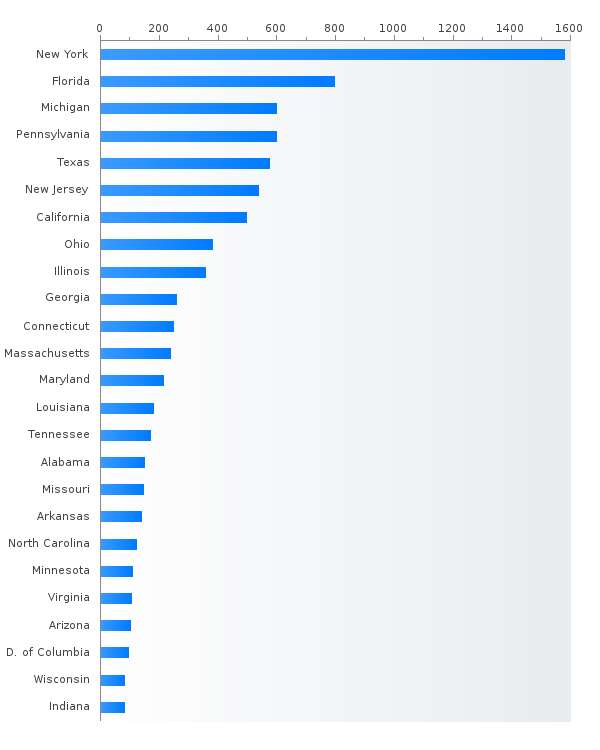
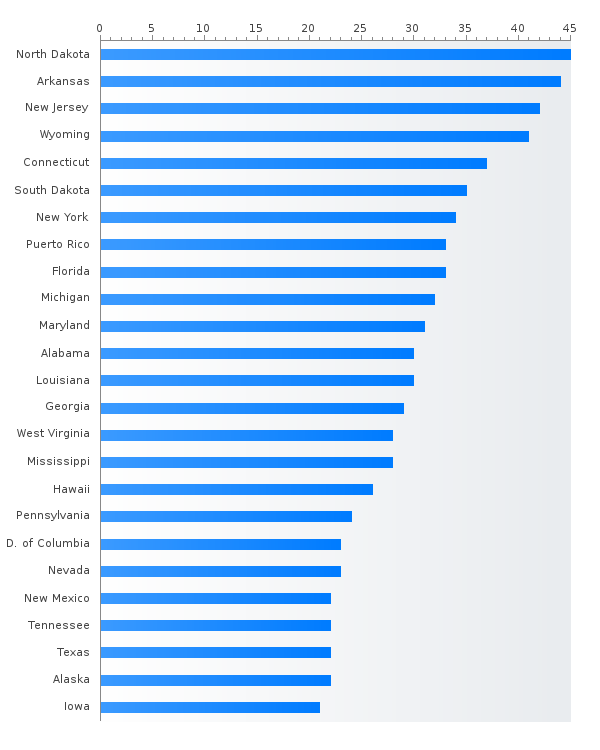
- When deciding whether a state is IMG friendly or not, there are two common approaches. The first approach considers the number of IMGs in a state to classify it as an IMG friendly or otherwise. On the other hand, the second approach looks at the percentage of residency positions filled by IMGs in that state. By themselves, both of these approaches are often inaccurate. For example, a state with a lot of residency positions will have a larger number of IMGs, even if the IMG match rate/percentage in that state is low. On the other hand, a state with a high IMG match rate may only have few IMGs if it offers a small amount of residency positions. In both of these situations, it would be incorrect to assume that these states are IMG-friendly. Thus, the best approach to classify a state as IMG friendly or otherwise is to look at both the number and the percentage of IMGs in that state. An ideal IMG-friendly state should have a lot of residency positions and a high IMG match rate. Regardless of the approach, an IMG still misses a lot of opportunities if they restrict their application to certain states only. If to take into account both factors the most IMG friendly states are New York, Florida, New Jersey, Michigan, Pennsylvania, Texas, and Ohio.
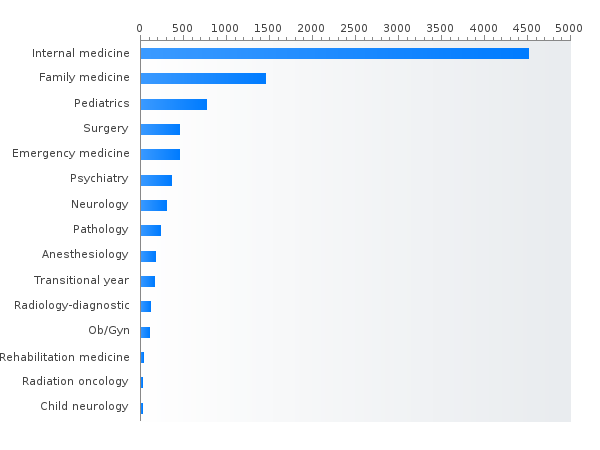
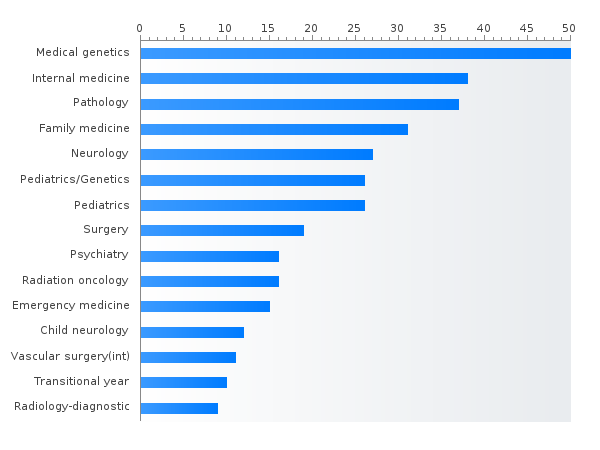
- Specialties like internal medicine, family medicine, pediatrics, pathology, neurology, psychiatry, and emergency medicine offer better chances of matching for IMGs because there aren't enough US seniors willing to fill all the available positions. On the other hand, specialties like plastic surgery, dermatology, urology ... are highly sought after by US seniors and offer very low chances for IMGs. Internal medicine and family medicine are friendliest by the number of positions filled by IMGs. IM and pathology are the friendliest by percent of positions filled by IMGs. Psychiatry, pediatrics and emergency medicine are the friendliest by match rate among IMGs. Considering all 3 factors together, internal medicine is likely the friendliest in general, but it depends on applicant's LORs and overall package. While it is important to look at the odds of matching in a particular specialty, we should also acknowledge that well-qualified IMGs can match at the highest sought-after positions as well.
let's look at the match rates for interviewed US and non-US IMGs who certified a rank order list by preferred specialty. But, it is important to note that under such a view, for example, thoracic surgery appears to have a relatively high match rate of 33% for US IMGs, but this figure is skewed by a very small sample size — only 3 applicants were interviewed and selected orthopedic surgery as preferred specialty. Applicants often think that just having a high Step 2 score makes them highly qualified. But reality is different. Yes, a high Step 2 score helps with interviews and correlates with the match probability, but even for internal medicine, 33% of non US-IMG IM applicants with Step 2 score grater than 260 do not match into preferred specialty. Numbers just shocking and while reasons may vary, it is evident that applicants with high scores are too confident and often can't effectively use free databases like Residency Explorer because all programs accept such scores and there is nothing to filter out by score. For average applicants, the situation is even worse, despite having the ability to select programs by typical score ranges. This highlights the necessity of identifying factors and programs that are truly IMG-friendly for a certain candidate if score is high or still unknown.
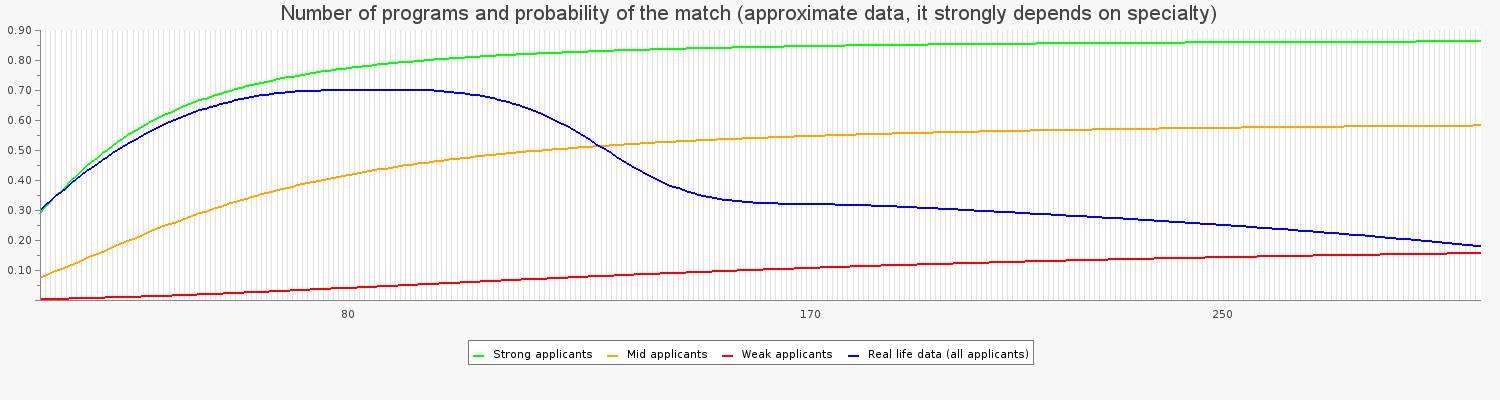
IMG friendly residency programs often receive thousands of applications and need to reduce this number to hundreds in some automated way. Programs use various approaches to achieve this goal. The probability of a successful match increases with the total number of applications by apply to programs with all types of various filtering algorithms that are used. According to NRMP research, the probability of a successful match stabilizes after 100-170 programs, depending on IMG applicant qualifications and specialty. The maximum probability of a match and a corresponding minimum number of programs to reach 90-95% of this probability is unique for each applicant and depends on the specialty and the applicant's qualifications. In general, the more competitive the specialty, the more programs needed to reach this individual probability maximum. The weaker the applicant, the lower the number of reasonable applications, and the more focus that should be placed on friendly positions. Selecting programs by suitable admission requirements, US/non-US IMG friendliness, graduation preferences, etc. helps to find the optimal programs to apply to.
Unfortunately, applicants cannot agree with each other to reduce the number of applications. Candidates should use the same number of friendly programs as others to keep chances equal. The number of friendly programs (that can consider candidate's application) correlates with interview chances and probability of the match. This correlation is linear for small numbers but essential saturation point exists if the number of friendly programs is high, and the probability near stabilizes after reaching of the certain number of applications.
According to our research, even the strongest IMG applicant needs to apply to at least 80 programs to have a good probability of a successful match. Mid applicants may need to apply to 120-150 programs. Weak applicants often try applying to a large number of programs, but the number of programs with suitable minimum requirements is limited and probability can't be increased to high levels even by applying to all programs. Weak applicants should strive to apply to all suitable programs but not just to a big number of programs.
Additionally, after selecting programs for signalling, applicants need to select only programs that offer interviews without signalling.
The blue graph shows that applicants who applied to 100 programs have best chances, in average, but this does not mean that particular applicant need to apply to 100 programs to have the best chances. This just mean that highly qualified applicants are majority of those who decided to apply to 80-100 programs.
Previous match statistics and minimum requirements are the key.
Basic list filters programs by minimum requirements and reduces the number of programs as much as it possible. If the number of programs is close to the one you wish to apply to, the BASIC list can be an optimal choice.
Using statistical data to increase the probability is a powerful tool in many fields. Our Advanced list uses statistical methods designed by PhD mathematician to order programs by probability. Overall number of residents, percent of US/Non-US IMGs, percent of residents from your geographical area and your country of graduation, your scores, and many other factors must be taken into account.
By selecting programs from the top and middle of the ranked part of the list, you can cover a high percent of really friendly positions with a reasonable number of applications.
First of all, the personalized list helps to apply to the right programs and increases interview probability.
Also, personalized list saves time you can spend on other preparations and finally increases the chance of a successful match this way too.
IMGs usually apply to more than 100 programs in order to match into a U.S. medical residency. The application is not free. For example, applying to IMG friendly residency programs in 2025 costs $330 for the first 30 programs and $30 for each additional program in the same specialty. If you applied to 100 programs, it would cost you $2430. Next 100 programs in the same specialty cost 3300$. It will be 5730$ for 200 programs.
Filtered list often saves thousands of dollars that you could spend on gaining more USCE, for example.
Many residency programs require US clinical experience and clearly mention this in their application requirements. Programs that do not require US clinical experience officially in their application guidelines may instead prefer applicants with prior US clinical experience. In reality, the probability of a successful match without US clinical experience is much lower than with US clinical experience. Without a doubt, USCE is absolutely mandatory for competitive specialties and for applicants with low USMLE scores. For IMGs, it is highly recommended to have as much USCE as possible.